
_2-2880w.jpg&w=3840&q=75&dpl=dpl_ANc7a4CfhxmpjQs36yEBqA57ZJ6L)
By Phillip Rupert ·
You didn't plan to think about your roof this year. Then the hail came, or a letter from your insurance company did. Now you've got a stack of quotes, a lot of pressure, and a number that makes your stomach drop.
Here's the part most roofers won't tell you. In Douglas County your roof is three problems at once. It's a hail problem, a fire-code problem, and an insurance problem. And most of the trade only makes money when you pick the biggest, most expensive fix.
I've been on Colorado roofs for a long time, and I'm on every job we do. This guide lays out every real option you have. It covers what each one actually costs, and how to tell which one your roof needs. Even when that answer saves you a tear-off.
The Bottom Line
- You've got four options after hail or with an aging roof, not one: repair, rejuvenation, full replacement, or a Class 4 hail upgrade.
- Colorado is the second-worst hail state in the country, and one storm on May 30, 2024 did about $2 billion in damage across metro Denver.
- A full asphalt replacement in the metro commonly runs about $15,000 to $28,000 (market estimate), so it pays to know whether you actually need one.
- Insurers are getting stricter about older roofs. In Colorado there's no law stopping them, so your roof's condition is the lever you control.
- The honest first step is a condition check, not a sales pitch. If your shingles still have life in them, you don't need a new roof.
Why roofs fail faster in Douglas County
Colorado is one of the hardest places in the country to own a roof, and hail is the main reason.
The state ranks second in the nation for hail insurance claims, behind only Texas, and it sits in what the industry calls Hail Alley (Rocky Mountain Insurance Association, via The Colorado Sun, 2025). Over the last ten years, hail has caused more than $5 billion in insured damage in Colorado (RMIIA, via Colorado Public Radio, 2024). This isn't a rare event. It's the weather here.
You don't have to go back far for proof. On May 30, 2024, a single hailstorm did about $2 billion in damage across metro Denver, the second-costliest hailstorm in Colorado history (Colorado Public Radio, 2024). One afternoon. That's the kind of season a roof here has to survive.
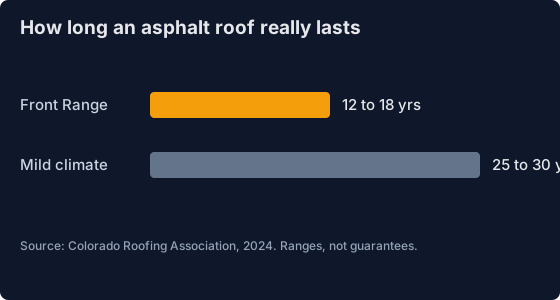
Source: Colorado Roofing Association, 2024.
An asphalt roof that would last 25 to 30 years in a mild climate often lasts closer to 12 to 18 years here (Colorado Roofing Association, 2024). Two things drive that.
First, the sun. At altitude the UV is stronger, and dry Colorado heat bakes the oils out of your shingles. It's the same thing that cracks the asphalt on your driveway. Your shingles get stiff and brittle, and brittle shingles don't shrug off a hit. Second, the hail. Every storm, big or small, knocks off granules and shortens the life your roof has left.
The point here isn't to scare you. It's to explain why a roof can look fine from the ground and still be aging faster than you think. That's exactly why the next part matters.
Your four options, honestly
Most homeowners think the choice is repair or replace. There are actually four paths, and the lowest-cost one that works is usually the right one.
- Targeted repair. If the damage is in one spot, like a few sections of shingles or a flashing leak, you fix that and move on. You don't need a whole new roof for a local problem.
- Rejuvenation. If your roof is sound but aging and stiff, a treatment can restore flexibility and buy years before you have to replace. This is the option almost nobody around here talks about. You don't have to replace your roof.
- Full replacement. When a roof is truly worn out, leaking, or badly hail-struck, you replace it. Sometimes that's the honest answer, and we'll tell you when it is.
- The Class 4 hail upgrade. When you do replace, you upgrade to an impact-resistant shingle so the next storm does less damage. More on that below.
Here's how the four compare at a glance:
| Option | Roughly what it costs | When it fits | What it buys you |
|---|---|---|---|
| Repair | Lowest | Damage is in one area | Fixes the problem spot, no tear-off |
| Rejuvenation | ~15 to 20% of a replacement (estimate) | Roof is sound but aging and stiff | Restored flexibility, a few more years |
| Full replacement | ~$15k to $28k (market estimate) | Roof is worn out or badly hit | A new roof, full lifespan |
| Class 4 upgrade | Part of a replacement | You're already replacing | An impact-rated roof for the next storm |
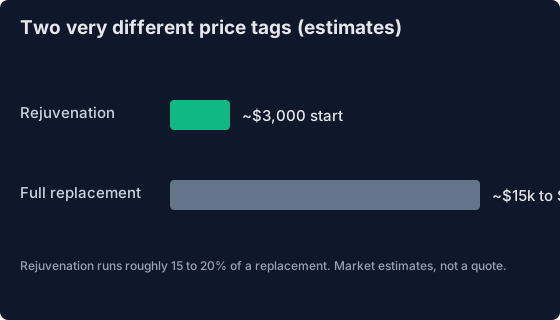
Sources: replacement range from Denver-metro market estimates; rejuvenation share from industry estimates. Both are ranges, not a Birdie quote.
Rejuvenation isn't right for every roof. Roughly one or two out of every ten roofs we look at are too far gone to treat, and those go to repair or replacement. But when a roof qualifies, treatment runs an estimated 15 to 20 percent of the cost of a replacement (industry estimate, 2026). That's a real difference, and it's worth knowing before you sign anything.
What a new roof really costs here
A full asphalt replacement in the Denver metro commonly runs about $15,000 to $28,000. That's exactly why it pays to know whether you actually need one.
That range is a market estimate, not a quote from us. Where you land depends on the size of your roof, how steep it is, the material you choose, and any code upgrades your home needs (Denver-metro roofing estimate, 2026). The steeper and more complex the roof, the higher the number.
Here's the honest part. A sound roof that's seven to ten years old may not need any of that yet. Plenty of the homes we look at are years away from a real replacement. The most expensive quote isn't automatically the right one. A roofer who leads with a tear-off before looking closely is telling you what's good for the roofer. Read more about when a repair is the smarter call.
Hail, your insurance, and the roof-age squeeze
Insurers are getting stricter about older roofs, and in Colorado there's no law stopping them. That means your roof's condition is the lever you control.
Start with how much hail already costs you. Along the Front Range, hail makes up roughly half of a typical homeowner's insurance premium (RMIIA, via Colorado Public Radio, 2026). You're already paying for this risk every month.
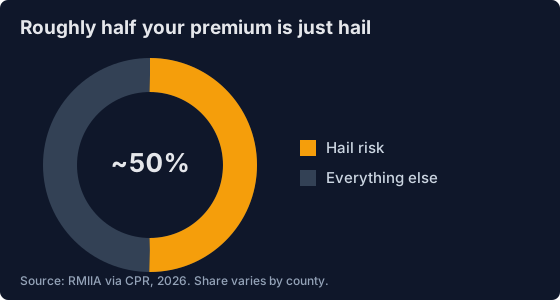
Source: Rocky Mountain Insurance Association via CPR, 2026. The hail share varies by county.
Now the squeeze. Across the country, insurers are moving older roofs from replacement-cost coverage to actual cash value. That pays out the depreciated value instead of the cost of a new roof. Some carriers are non-renewing older roofs outright. This is a national trend, not a Colorado law.
And in Colorado, the law doesn't protect you the way people assume. There's no state statute or Division of Insurance rule that shields you here. A carrier can non-renew or cut your roof coverage over its age or condition. The state's own consumer guidance explains that insurers must give notice and a reason, but it doesn't limit the reasons (Colorado Division of Insurance, "When Your Homeowners' Insurance Doesn't Renew"). State law does require at least 60 days written notice before a non-renewal that isn't about nonpayment (Colorado General Assembly, HB 23-1174, 2023). That's the protection you get: a warning, not a shield.
So here's the honest framing. It's not really about your roof's age. It's about its condition. Age is a number a carrier can point at. Condition is something you can actually do something about, and it's the thing a good roofer can help you get ahead of. What Colorado insurers can and can't do about your roof is worth understanding.
The wildfire code most homeowners haven't heard of
Colorado now has a statewide wildfire building code. If your home is in a higher-risk foothills area, it changes what roof you're allowed to put on.
It's called the 2025 Colorado Wildfire Resiliency Code. In the wildland-urban interface, the zones where homes meet wildland and fire risk is highest, the code requires a Class A roof. That's the top fire-resistance rating (Colorado Division of Fire Prevention and Control, 2025). It applies to new construction and to work that reconstructs or replaces your roof covering.
Two honest caveats, because the details matter. First, the code is adopted and enforced locally. Your city or county's authority decides which areas count as wildland-urban interface and when the code applies. Second, it doesn't mean every Douglas County home is under it. It applies in designated foothills-type zones once your jurisdiction adopts it. If you're up against the foothills, it's worth asking. If you're in a flatter suburban part of the county, it may not touch you yet.
Worth a quick check: If your home sits near open space or the foothills, ask whether it falls in a designated wildland-urban interface zone before you replace your roof. It can change which materials you're allowed to use. Colorado's wildfire roof code, explained.
Class 4 shingles and the hail upgrade
If you do replace, a Class 4 impact-resistant shingle is the upgrade that helps your roof survive the next storm. Many carriers give a premium credit for it, too.
We put a Class 4 shingle on every replacement we do. In a place that ranks second in the country for hail, that's not an upsell. It's just the right way to build a roof here. A Class 4 shingle is rated to take an impact that would crack an ordinary shingle. That means less damage the next time the sky turns green.
That credit is real, but be careful how you read it. Some carriers offer a premium credit for impact-resistant roofing. It's often cited in the range of 15 to 30 percent, but that figure is carrier-specific and isn't guaranteed by any Colorado law (roofing industry estimate, 2025). Check with your own insurer for what they actually offer.
Colorado is starting to push these resilience credits toward something you can count on. Two new laws move in that direction. HB25-1182 took effect July 1, 2026. It requires insurers to factor structure-hardening into their wildfire risk models and to show homeowners their risk score. SB26-155, effective August 12, 2026, will require insurers to file data on the credits they give for resilient roofs (Colorado General Assembly, HB25-1182; SB26-155). That filing requirement phases in later. The short version: a stronger roof is getting easier to get credit for, not harder.
How to tell what your roof actually needs
The honest first step is a condition check, not a sales pitch. If your shingles still have life in them, you don't need a new roof.
There are a few signals you can see yourself. Shingles that are curling, cracking, or dropping granules into your gutters are aging. Bare spots, bald patches, or shingles that feel brittle and snap instead of bending are further along. A roof that still lies flat and flexes a little has life left.
When we come out, we do an honest condition check and tell you which of the four paths fits. If the roof is sound, we say so, and we treat it or repair it instead of selling you a tear-off. If it's truly done, we tell you that too, and we build it back right with a Class 4 shingle. I've spent 34 years in this trade, and my name is on the truck and on your roof. The straight answer is the whole point.
See if your roof qualifies. Call Phil at (720) 254-2521 for a straight-answer condition check.
Frequently Asked Questions
How much does a new roof cost in Douglas County?
A full asphalt replacement in the Denver metro commonly runs about $15,000 to $28,000, depending on size, pitch, and material (Denver-metro estimate, 2026). That's a market range, not a quote. The honest note: a sound, aging roof often needs a repair or a treatment instead, for a fraction of that.
Do I have to replace my roof after hail?
Not always. Hail damage can be local, and a targeted repair may be all you need. If the roof is sound but aging, a rejuvenation treatment can restore flexibility and add years. Replacement is for a roof that's truly worn out or badly struck. A condition check tells you which. Does roof rejuvenation actually work?
Will my insurance drop me because my roof is old?
It can. Colorado has no law that stops a carrier from non-renewing or reducing coverage over roof age or condition. The state only requires notice and a reason, at least 60 days in advance (Colorado Division of Insurance; HB 23-1174). The lever you control is condition, which is why getting ahead of it matters. Colorado roofs and insurance.
What roof does Colorado's wildfire code require?
In designated wildland-urban interface zones, the 2025 Colorado Wildfire Resiliency Code requires a Class A roof, the top fire rating (Colorado DFPC, 2025). It's adopted locally, so whether it applies depends on your jurisdiction and whether your home is in a designated zone.
Is roof rejuvenation worth it?
For a sound, aging roof, it can add years for a fraction of a replacement's cost, and it's not right for every roof. The honest answer depends on your roof's condition.
The honest takeaway
Your roof in Douglas County is a hail problem, a fire-code problem, and an insurance problem at the same time. That's a lot. But it doesn't always mean the biggest, most expensive fix.
- You've got four options, not one: repair, rejuvenation, replacement, or a Class 4 upgrade.
- Condition matters more than age, and it's the part you can act on.
- The lowest-cost fix that actually works is usually the right one.
Before you sign a replacement contract, get a straight answer about what your roof actually needs. Call Phil at (720) 254-2521 to see if your roof qualifies for a condition check. You don't have to replace your roof.
